Proteoforms in clinical research
Proteoforms play a key role in biological processes. A clear example are antibody proteoforms, whose structural variability enables the fine-tuning of immune responses, while also can drive pathogenic responses. In our group, we focus on dissecting proteoform heterogeneity with particular emphasis on how these differences manifest across diseases and stages of disease progression. To that end, we develop and apply innovative MS approaches and integrate information from multiple levels of analysis (e.g. intact mass, bottom-up, released glycans) to resolve and interpret the structural complexity of proteoforms.
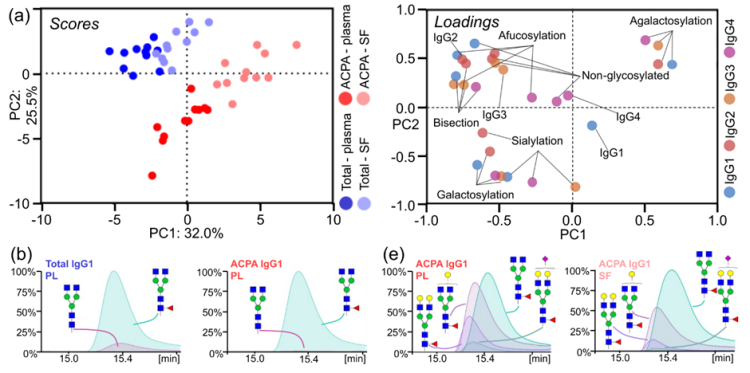
IgG proteoforms define ACPA and total IgG fractions in plasma (PL) and synovial fluid (SF) in rheumatoid arthritis patients. Advanced Science, 2025, 12, 2408769.
Proteoform-resolved binding and glycointeractomics
Proteoform-specific interactions are notoriously hard to study. The reason, is that current techniques for measuring binding and affinity do not provide specific information for individual co-existing proteoforms (e.g. glycoforms). Over the last years, our group is dedicated to developing new techniques that provide an integrated view of proteoform-specific affinities from heterogeneous protein preparations. In particular, the Proteoform Profiling group has developed a novel assay based in affinity capillary electrophoresis (affinity CE) in combination with MS allowing us to assess dozens – and potentially even more – proteoforms and glycosylation variants in a single experiment.
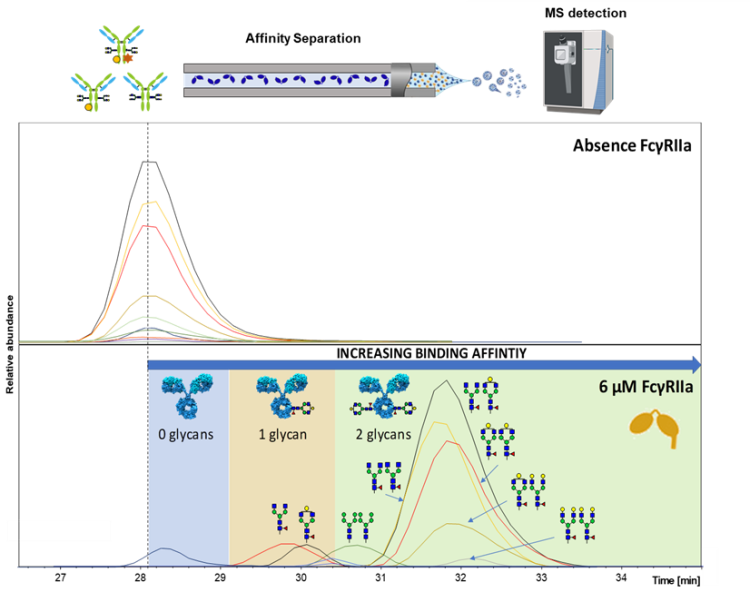
Affinity Capillary Electrophoresis – Mass Spectrometry resolve glycan-specific interactions of mAbs. Front. Immunol, 222, 13, 980291.
Biopharmaceuticals
Many therapeutic strategies rely on protein-based drugs which often exhibit a high degree of molecular heterogeneity. This heterogeneity is critical, as it can strongly influence the efficacy, safety and pharmacokinetic/pharmacodynamic (PK/PD) behavior of these therapeutics. In collaboration with biopharmaceutical companies and large EU consortia, we are committed to developing an applying advanced MS-based analytical techniques to characterize biopharmaceuticals and their in-vivo biotransformation products. Our current efforts focus on monoclonal antibodies and fusion proteins as well as gene therapy products such as adeno-associated viruses (AAVs).